
Description
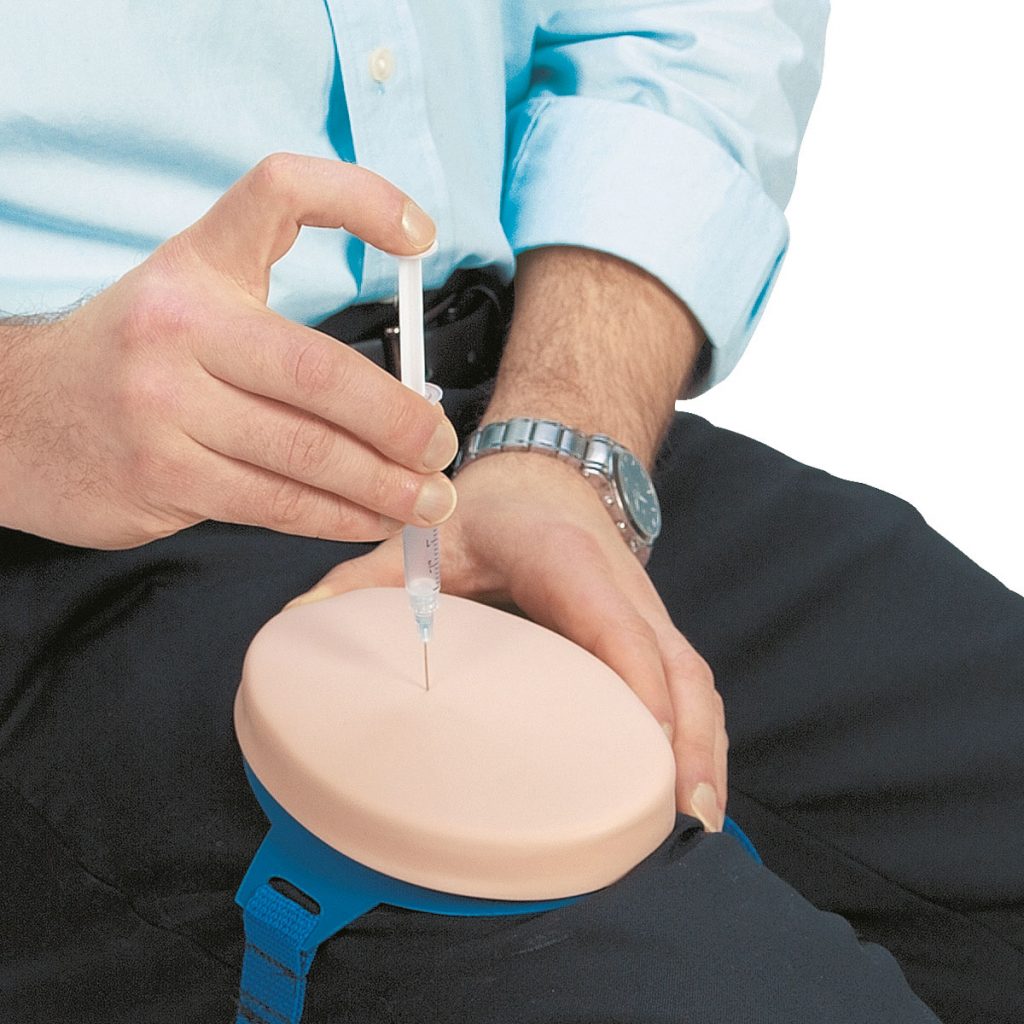
This pad that looks and feels like human skin is ideal for diabetic instruction and injection practice. May be worn on the body in specific locations (stomach, thigh, upper arm) to allow patients to inject fluid into the pad to practice giving themselves injections. Pad is thick enough to accept all insulin needles. For safety purposes, the 6-1/4″ L x 4-1/4″ W x 3/4″ D oval pad has a hard plastic backing to prevent the needle from poking through the pad and into the wearer’s skin. Has a 1″ wide nylon strap with an adjustable plastic buckle.
Why Choose the Diabetic Injection Pad (WA18238U) for Your Diabetes Education Programme or Nursing Skills Lab in India?
The Diabetic Injection Pad (Item No. WA18238U) is a wearable insulin self-injection training pad from Nasco Healthcare, USA — designed for diabetes educators, ASHA and ANM workers, hospital diabetes clinics, nursing colleges, and community health programmes in India where insulin self-injection training is a patient care priority.
With over 100 million people living with diabetes in India and insulin therapy increasingly initiated at the primary care level, the gap between insulin prescription and safe, confident self-injection technique is one of the most significant patient education challenges in Indian diabetes care. The Diabetic Injection Pad bridges this gap by giving newly diagnosed insulin-dependent patients — and the nurses and community health workers supporting them — a safe, realistic, and immediately wearable practice tool for insulin injection technique before the first live self-injection.
Worn on the body — trains the real injection experience:
The pad straps directly onto the patient’s or trainee’s body at all three standard insulin injection rotation sites:
- Abdomen (stomach) — the fastest insulin absorption site and most commonly used for rapid-acting insulin
- Thigh (upper outer) — slower absorption, commonly used for intermediate-acting insulin
- Upper arm (outer aspect) — used for certain insulin regimens with nurse or carer assistance
By wearing the pad at the actual injection site on the actual body, the patient practises the real experience — pinching the skin, choosing the angle, pressing the needle through skin-like resistance — not a flat tabletop exercise. This is the closest available approximation to real self-injection practice before the actual first injection.
Safe for real-body wear — hard plastic backing:
A rigid hard plastic backing is embedded in the pad directly behind the injection surface. This backing prevents any needle — regardless of length — from penetrating through the pad and into the wearer’s skin. The pad is safe to wear and inject on a real human body for training purposes.
Compatible with all insulin needles:
The pad’s thickness and surface resistance is calibrated to accept all standard insulin pen needles — 4 mm, 6 mm, 8 mm, and 12.7 mm — and insulin syringes, replicating the tactile resistance of real subcutaneous tissue across needle lengths.
Specifications:
- Pad dimensions: 15.9 × 10.8 × 1.9 cm (6¼ × 4¼ × ¾ in.)
- Weight: 0.179 kg
- Strap: 1-inch wide nylon strap with adjustable plastic buckle
- Material: Skin-like synthetic pad with hard plastic safety backing
Why Buy from SEM Trainers?
SEM Trainers & Systems has over 30 years of experience supplying health education and clinical training tools to 1,500+ institutions across 28 states in India. We provide pan-India delivery and dedicated after-sales support. For diabetes education programme equipment packages or bulk ASHA/ANM worker training supplies, contact us for institutional pricing.
Q: Is this pad safe to wear on a real person’s body during practice?
A: Yes. The hard plastic backing inside the pad prevents any needle from penetrating through the pad into the wearer’s skin. The pad is specifically designed to be worn on a real body at the abdomen, thigh, or upper arm injection sites.
Q: What insulin needle sizes does this pad accept?
A: All standard insulin pen needle lengths — 4 mm, 6 mm, 8 mm, and 12.7 mm — and standard insulin syringes. The pad thickness replicates subcutaneous tissue resistance across all commonly used needle lengths.
Q: Which three injection sites can the pad be worn at?
A: Abdomen (stomach), upper outer thigh, and outer upper arm — the three standard sites used in insulin injection rotation therapy.
Q: Is this suitable for patient self-injection education or only healthcare provider training?
A: Both. The pad is designed primarily for patient self-injection education — giving newly diagnosed insulin-dependent patients a safe way to practise their own injection technique before their first real self-injection. It is equally suitable for nursing staff and ASHA/ANM worker training in insulin injection technique.
Q: Does the pad look and feel like real skin?
A: Yes. The surface is designed to look and feel like human skin, providing realistic tactile feedback on needle insertion angle and depth — the two most important elements of insulin injection technique.
Q: Can actual insulin or fluid be injected into the pad?
A: Yes — fluid can be injected into the pad for a complete end-to-end practice experience including plunger depression and injection completion.
Reviews
There are no reviews yet.