What an inspection-ready skills laboratory actually needs — mandated trainers, quantities, infrastructure, and the procurement decisions that clear an NMC audit.
SEM Trainers & SystemsNMC · INC · NCISM~9 min read
Every medical college in India now has to run a Skills Laboratory — it stopped being optional the moment the National Medical Commission tied Competency-Based Medical Education to recognition. But “set up a skills lab” and “set up a skills lab that clears inspection” are two different projects, and the gap between them is where colleges lose time, money, and sometimes a renewal cycle.
This guide lays out what an NMC-compliant skills lab actually needs: the mandated equipment with quantities, the infrastructure inspectors check, and the procurement decisions that separate an inspection-ready lab from an expensive room full of unused manikins.
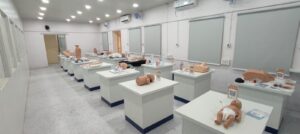
A complete skills lab equipped by SEM Trainers & Systems — each station mapped to a clinical competency.
The principleWhat the NMC means by a “Skills Laboratory”
Under the CBME framework, the skills lab is the safe environment where students learn, practise and are assessed before they touch a patient. Inspectors look for two things: every skill in the curriculum must have a place to be practised, and every model must come with a defined training module — objectives, method, and assessment.
For procurement, that means you are not buying a shopping list of manikins. You are buying a curriculum-mapped capability — the right trainers, in the right quantities, with the documentation proving each one teaches a specified competency.
The listMandated equipment & minimum quantities
The trainers below are the part-task models most commonly specified for an intake of about 100 students. These are minimums — larger intakes scale up, and figures are revised by NMC notifications, so confirm against the current circular before raising a purchase order.
Skill areaTrainer / manikinMin
IV & IM injection
Injection arms & gluteal pads
5
Catheterisation
Male & female trainers
4
Suturing
Skin suturing pads / arms
5
Obstetrics
Delivery & pelvic trainers
4
Resuscitation
CPR manikins with feedback
4
Airway
Tracheal intubation trainers
4
Examination
Breast examination trainers
2
Advanced (desirable)
High-fidelity patient simulator
Opt
Each model should ship with a written training module, and every electronic trainer should be backed by a maintenance plan — inspectors increasingly check whether equipment is functional, not just present.
The roomInfrastructure inspectors check
A skills lab can’t be a single open hall. The NMC expects a partitioned clinical environment — and these spaces count toward compliance as much as the trainers do.
Schematic layout — minimum 4 examination rooms (8 preferred), each with AV recording, plus demo, debriefing, practice, storage and faculty spaces.
The audio-visual recording requirement is the one colleges most often under-budget. It’s mandated, not optional — and retrofitting it after the lab is built costs far more than specifying it up front.
The pitfallsWhere compliant labs go wrong
Refurbished sold as newFails early and can fail inspection. Insist on genuine units with warranty and an OEM authorisation letter.
No faculty trainingTrainers get locked in cupboards — “present” but not “functional.”
Zero maintenance budgetElectronic manikins need calibration. One that won’t switch on at audit counts against you.
Piecemeal buyingMismatched warranties, no accountable partner, gaps that surface during inspection.
The hardwareGenuine equipment, mapped to the curriculum
Inspection-grade training needs inspection-grade hardware. SEM Trainers & Systems supplies genuine, new equipment as an authorised Indian distributor of:
Just as important as the box is what happens after delivery: on-site installation, faculty training so the lab is actually used, and maintenance support so it stays functional for inspections. That lifecycle support is usually the difference between a lab that clears audit and one that scrambles before every renewal.
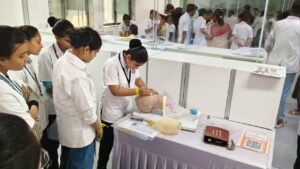
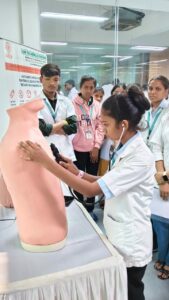
Hands-on airway management trainingStudents training on SEM Trainers equipment
Before you buyYour inspection-ready checklist
NMC compliance mapping matrix — each item tied to the competency and quantity it satisfies.
Genuine-product confirmation — manufacturer warranty and OEM authorisation.
Installation & faculty-training plan — not just delivery.
AMC / maintenance terms for all electronic trainers.
References from existing medical or nursing colleges.
FAQCommon procurement questions
Who is the authorised distributor of Nasco, Kyoto Kagaku and PRESTAN in India?
SEM Trainers & Systems, based in Valsad, Gujarat, is an authorised Indian distributor of Nasco Healthcare, Kyoto Kagaku, 3B Scientific, PRESTAN, Trucorp, Simulaids, ZOLL and Gaumard — supplying genuine equipment with installation, faculty training and maintenance support across India.
Is the equipment list the same for nursing colleges?
The principle is the same, but nursing programmes follow Indian Nursing Council (INC) norms, which specify their own laboratory requirements for GNM and B.Sc. Nursing. A compliant supplier maps to INC for nursing labs and NMC for medical colleges.
How many students does a standard skills lab equip?
The minimums here are framed around an intake of about 100 students. Higher intakes scale the quantities up — confirm your exact figures against the current NMC notification.
How do we know if our existing lab is compliant?
The fastest way is a structured gap check against the current NMC requirements. SEM Trainers offers a free NMC Compliance Audit that maps your existing equipment and infrastructure against the mandated list and flags what’s missing before an inspector does.
Equipment quantities and infrastructure norms cited here are commonly specified minimums and are revised periodically by NMC, INC and NCISM. Verify against the latest official notification, or request a current mapped checklist as part of a compliance audit.
Free · No obligation
Not sure your lab would clear inspection today?
Book a free NMC Compliance Audit. We map your current skills lab against the latest NMC, INC and NCISM requirements — item by item — and give you a clear gap report: what’s compliant, what’s missing, and what to prioritise before your next renewal.
Medical colleges across India are upgrading their CPR training stations. The shift toward competency-based lab standards means procurement officers now face a clearer set of product requirements—but only if they know what to look for. Half-body CPR manikins with feedback mechanisms have become standard in recent tenders, yet many institutions still specify equipment without understanding the durability, parts-availability, and warranty factors that determine long-term compliance.
This guide walks you through the product specifications that matter most when sourcing CPR training equipment. Whether you’re responding to a tender, planning a lab refresh, or auditing your current inventory, understanding these features helps you avoid costly replacements and ensures your trainees get reliable, consistent feedback during practice sessions.
Key Features to Look For in Modern CPR Training Equipment
Prestan Professional Adult CPR-AED Manikin — available from SEM Trainers & Systems
Real-time feedback mechanisms are now table stakes in CPR manikin procurement. When a trainee performs chest compressions, they need immediate visual or audio cues about compression depth and rate. This direct feedback maps to psychomotor competency markers in nursing education frameworks. Look for manikins that display compression depth in centimeters and compression rate in beats per minute—either via built-in LED indicators, audio tones, or connected mobile apps.
Durability under repeated use is equally critical. Medical colleges run 50+ compressions per student per session. A manikin used across multiple cohorts annually faces 10,000+ compression cycles. Manufacturers like Prestan, Gaumard, and TruCorp engineer their half-body units to withstand this volume without degradation to the sternum, ribs, or feedback sensors. When evaluating a product, ask the supplier for documented compression-cycle lifespan and request evidence of field performance across similar-sized institutions.
Replacement-parts availability and warranty terms deserve contract-level attention. A manikin that fails mid-academic year creates training gaps. Verify that your supplier stocks replacement parts—sternum pads, compression sensors, battery modules—within 48 hours of order. Warranty coverage should span 3+ years and explicitly cover wear-and-tear on high-use components. SEM has equipped 320+ skills labs across 28 states since 1995, and the pattern is consistent: institutions that specify parts-availability timelines and warranty scope in their BOQ avoid compliance disruptions.
What Product Specifications Actually Mean for Trainees
A compression-depth indicator is not a luxury feature—it is a learning tool. Trainees cannot reliably judge their own compression depth by feel alone. Studies in medical education show that visual feedback accelerates skill acquisition and reduces performance variability across cohorts. When a manikin displays “5.2 cm depth” or “110 compressions/min,” the trainee has objective data to adjust technique in real time. This directly supports competency-based assessment.
Feedback accuracy matters more than feedback type. A manikin with a visual indicator that drifts out of calibration after 500 compressions creates false confidence in trainees. They practice with inaccurate feedback and develop poor technique. Conversely, a manikin with verified indicator accuracy—calibrated and documented before deployment—ensures every trainee receives consistent, reliable cues. When sourcing equipment, request calibration certificates and ask whether the supplier offers periodic recalibration services.
Cleaning protocol compatibility is often overlooked but critical for infection control. CPR manikins are high-touch equipment. The manikin’s materials, feedback sensors, and battery compartments must tolerate standard hospital-grade disinfectants without degradation. Some manikins have sealed sensor modules; others have exposed electronics that corrode under repeated cleaning. Clarify cleaning protocols with your supplier before purchase. A manikin that requires special handling or expensive maintenance adds hidden costs.
How to Evaluate a Supplier Before Signing a BOQ
Supplier track record matters. Ask how many skills labs the supplier has equipped in your state and across India. SEM’s 30+ years of experience across 3,000+ institutions in 28 states provides a reference point for institutional knowledge and supply-chain reliability. A supplier with deep experience understands the specific compliance frameworks your college operates under and can anticipate procurement timelines and regulatory shifts.
Request spec sheets tied to your exact intake size and station count. A 100-student intake requires different equipment density and spare-parts strategy than a 200-student intake. A supplier who offers layout diagrams, floor plans, and station-placement guidance demonstrates institutional knowledge. They can advise on traffic flow, debrief-room placement, and storage logistics—factors that affect both training outcomes and equipment longevity.
Verify multi-brand access. No single manufacturer dominates every use case. A supplier who distributes 14+ international brands—including Prestan, Gaumard, Nasco Healthcare, and TruCorp—can match your specific requirements without forcing you into a single-vendor lock-in. This flexibility also protects you if a preferred brand faces supply disruptions. Ask the supplier to compare product specs across brands and justify their recommendation based on your intake size, budget, and durability requirements.
Common Procurement Considerations Worth Reviewing
Budget cycles and tender timelines create pressure to specify equipment quickly. Resist the urge to copy specs from peer institutions without verification. Your college’s lab layout, student intake, and training protocols may differ significantly. A manikin that works well in a 150-bed teaching hospital may not suit a 50-student nursing college. Customize your specifications to your actual needs.
Warranty and service agreements often hide cost surprises. A low-cost manikin with a 1-year warranty and slow parts-replacement timelines may cost more over five years than a higher-priced unit with 3+ year coverage and 48-hour parts availability. Calculate total cost of ownership, not just purchase price. Include warranty scope, parts costs, and downtime risk in your comparison.
Defibrillation-pad compatibility is a practical detail that affects training realism. If your college plans to integrate automated external defibrillator (AED) training with CPR practice, verify that your chosen manikin accepts standard defibrillation pads and that the feedback mechanism integrates with AED simulators. Mismatched equipment fragments the training experience.
Frequently Asked Questions
What is the difference between half-body and full-body CPR manikins?
Half-body manikins focus on chest-compression technique and feedback. They fit tight lab spaces and meet competency-based training requirements for CPR. Full-body manikins add airway management and ventilation practice but require more floor space and higher budgets. Most Indian medical colleges prioritize half-body units for dedicated CPR stations and add full-body manikins for integrated airway-management modules.
How long does a CPR manikin feedback mechanism typically last?
Compression-depth indicators and rate sensors are engineered for 10,000+ cycles before degradation. However, lifespan depends on maintenance, cleaning protocols, and battery management. Manikins used in high-volume settings (50+ compressions per student per session) may require sensor replacement after 18–24 months of continuous use. Request documented field-performance data from your supplier.
How do I evaluate a supplier’s parts-availability claim?
Ask for a parts-inventory list and request a sample order timeline. Contact the supplier’s existing customers in your region and ask about actual replacement-parts delivery times. A supplier claiming “48-hour delivery” should provide documented evidence through customer references. Also verify whether parts are stocked locally or imported, as import delays can extend timelines significantly.
Should I prioritize visual or audio feedback indicators?
Both have merit. Visual indicators (LED displays showing depth and rate) suit classroom settings where multiple trainees observe. Audio indicators (beeps or tones) work well for individual practice and provide real-time cues without requiring the trainee to look away. Many modern manikins offer both. Choose based on your lab layout and training protocols.
The Bottom Line
CPR manikin procurement is not just about purchasing equipment—it is about ensuring consistent, reliable trainee feedback and protecting your college from compliance disruptions. Prioritize real-time feedback mechanisms, documented durability under repeated use, and supplier access to replacement parts within realistic timelines. Evaluate suppliers based on institutional track record, multi-brand access, and willingness to customize specifications to your college’s actual needs. Calculate total cost of ownership over 3–5 years, not just purchase price.
SEM Trainers & Systems has equipped 320+ skills labs across 28 states over 30+ years. We distribute 14 international brands and offer free site visits to help you design lab layouts, specify equipment, and co-develop your BOQ. If you are planning a CPR station upgrade or responding to a tender, book a consultation with our team. We can walk through your current inventory, identify gaps, and recommend equipment that aligns with your intake size and training protocols.
**Book a free site visit:** https://semtrainers.com/about-us
—
Disclaimer: This article provides general information based on publicly available references and SEM Trainers & Systems product knowledge. It is not regulatory or legal advice. Procurement decisions should be guided by your institution’s official compliance handbook, the current NMC/INC/NCISM published guidelines, and qualified advisors. Product specifications referenced are those of the respective manufacturers. SEM Trainers & Systems does not guarantee regulatory approval of any third-party product.
NMC Compliant Medical Manikins India: Complete 2026 Buyer’s Guide for Medical Colleges
As medical education in India continues to evolve under the guidelines of the National Medical Commission, simulation-based learning is no longer an enhancement , it is a mandate.
For institutions establishing or upgrading skills laboratories, investing in NMC compliant medical manikins India has become central to regulatory compliance, academic excellence, and patient safety.
This 2026 buyer’s guide will help medical colleges understand:
What qualifies as NMC compliant
Which simulation equipment is essential
How to select the right suppliers
How to future-proof your skills lab infrastructure
What Does “NMC Compliant” Mean?
Under Competency-Based Medical Education (CBME), the NMC mandates structured skills labs to ensure students develop hands-on clinical competence before interacting with patients.
When we refer to NMC compliant medical manikins India, we mean simulation equipment that:
Supports competencies defined by NMC curriculum
Aligns with official medical college equipment requirements
Enables structured skill training and OSCE-based assessment
Is durable, serviceable, and audit-ready
Includes documentation, SOPs, and faculty training support
Compliance is not about owning equipment, it is about operational readiness.
During inspections, institutions are evaluated not only on inventory but also on usage, maintenance, and competency mapping.
Core Simulation Equipment Required for NMC Skills Labs
While exact quantities vary based on intake capacity, most Indian medical colleges must include the following foundational categories:
1. Basic Life Support (BLS) & CPR Trainers
Adult, child, and infant CPR manikins with compression feedback mechanisms are mandatory for emergency response competencies.
These trainers support:
Cardiopulmonary resuscitation
AED familiarization
Team-based code blue drills
Objective skill evaluation
2. Airway Management Trainers
Airway simulators allow repeated practice of:
Endotracheal intubation
Bag-valve mask ventilation
Suction techniques
Difficult airway scenarios
These are essential for emergency medicine and anesthesiology exposure.
3. Obstetric & Neonatal Simulation Trainers
India’s public health priorities make obstetric and neonatal training critical.
Required trainers include:
Normal delivery simulators
Complicated labour management models
Neonatal resuscitation trainers
These simulators directly support maternal and child health competencies under CBME.
4. Procedural Skill Trainers
Repetitive hands-on practice is essential for clinical confidence.
Common procedural trainers include:
IV cannulation arms
Injection pads
Suturing models
Catheterization trainers
Lumbar puncture simulators
Additionally, many institutions now integrate buy anatomical models for medical training online India solutions for anatomy correlation and demonstration-based teaching.
5. Advanced & High Fidelity Simulation Systems
High-acuity emergency and ICU scenarios require advanced systems capable of:
Cardiac rhythm simulation
Respiratory distress modeling
Drug response simulation
Real-time physiological feedback
Team-based crisis training
High Fidelity Medical Simulators Suppliers in India: What to Look For
When evaluating high fidelity medical simulators suppliers in India, institutions should assess beyond product specifications.
Key considerations include:
1. Clinical Accuracy
Does the simulator replicate real-time physiological responses accurately?
2. Faculty Training Support
Does the supplier provide structured faculty development workshops?
3. Technical Service Network
Is there local service support in your region — including distributors in Gujarat, Maharashtra, Delhi, or South India?
4. Software & Scenario Updates
Does the system allow upgrades aligned with evolving curriculum requirements?
5. Integration with Virtual Reality Medical Training Equipment in India
Many modern labs now integrate virtual reality medical training equipment in India for immersive anatomy, emergency response drills, and surgical planning modules.
VR does not replace manikins, it enhances cognitive immersion before procedural execution.
Virtual Reality Medical Training Equipment in India: The Emerging Layer
Forward-thinking colleges are expanding simulation ecosystems with:
VR anatomy modules
AR-assisted procedural overlays
Immersive emergency scenario training
Remote simulation broadcasting
While NMC compliance focuses primarily on core skills labs, integrating virtual reality medical training equipment in India enhances:
Cognitive rehearsal
Pre-clinical conceptual clarity
Surgical orientation
Interdisciplinary simulation
Institutions aiming to position themselves as Centers of Excellence increasingly combine manikins, anatomical models, and immersive technologies.
Strategic Procurement Checklist for 2026
Choosing medical manikins should be a long-term academic decision — not just a tender process.
1. Curriculum Mapping First
Start with competency lists. Then identify equipment.
2. Plan for 5–7 Year Scalability
Student intake often increases. Choose modular systems.
3. Ensure Documentation Readiness
Maintain:
Equipment SOPs
Usage logs
Maintenance records
Faculty training certifications
Inspectors evaluate operational functionality.
4. Collaborate with Established Simulation Providers
Work with suppliers experienced in setting up complete skills labs across India — including institutions in Ahmedabad, Mumbai, Bengaluru, and other major academic hubs.
Conclusion: A Compliance Roadmap for 2026
Establishing a skills lab is not about purchasing equipment — it is about building a competency-driven learning ecosystem aligned with the standards of the National Medical Commission.
Medical colleges planning upgrades in 2026 should:
Conduct a structured compliance audit
Map simulation needs to curriculum
Evaluate high fidelity medical simulators suppliers in India
Integrate anatomical and virtual learning layers
Develop a long-term expansion roadmap
The future of Indian medical education is simulation-driven, competency-focused, and technology-enhanced.
The institutions that prepare now will lead tomorrow.