

Description
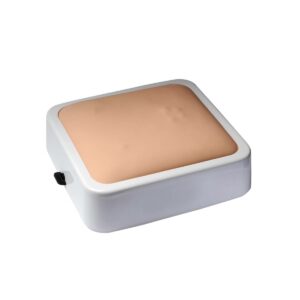
The Prostate Examination Trainer is used in medical simulation and clinical training for the demonstration and practice of digital rectal examinations (DRE). The trainer includes 4 different prostates to train professional palpation methods (side position or bent forward) and diagnostic skills associated with rectal examinations.
The index finger is inserted into the rectum, facilitating palpation of the rear part of the prostate, where the majority of prostate carcinomas are found. The shape, position and consistency of the prostate are assessed, allowing irregularities, induration and nodes on the otherwise smooth surface of the prostate to be felt.
The following stages are included:
- Normal prostate
- Advanced prostate carcinoma
- Prostate carcinoma at an early stage
- Benign prostatic hyperplasia (BPH)
For reference and self-control, the trainer also includes the corresponding transrectal sonographic imaging (transrectal ultrasound, TRUS) for each stage. While in use, the prostate and the sonographic images are hidden and cannot be seen by the trainee.
The compact shape of the DRE Trainer makes it easy to store and the perfect skill trainer for every medical simulation lab.
Why Choose the Prostate Examination Trainer, 4 Stages (P58/1) for Your Clinical Skills Programme in India?
The Prostate Examination Trainer, 4 Stages (Item No. 1013116 / P58/1) is a compact, standalone DRE palpation and clinical interpretation trainer from 4B Scientific / 3B Scientific, Germany — designed for medical students, urology trainees, general practice residents, and family medicine students in India who need to develop both the tactile discrimination skills of prostate palpation and the clinical reasoning skills of correlating DRE findings with diagnostic imaging. At 0.18 kg and 9.5 × 9.5 cm, it is the most portable clinical interpretation trainer in the SEM prostate range — and the only one that integrates transrectal ultrasound (TRUS) imaging correlation for each of the four prostate stages.
How the Trainer Works:
The trainer presents four individually palpable prostates — Normal, BPH, Early Carcinoma, and Advanced Carcinoma — each accessible via a dedicated gloved finger port. The trainee inserts one finger, palpates the prostate, and records their findings: shape, size, consistency, surface regularity, presence of nodules or induration. The corresponding TRUS sonographic image for each stage is included in the trainer but is concealed from the trainee during examination — revealed only after the palpation assessment is complete. This hidden imaging design creates a genuine clinical reasoning loop: palpate, describe, predict, then verify against the TRUS image — the same cognitive process a clinician uses when correlating DRE findings with imaging in a urology outpatient setting.
Two Examination Positions Supported:
The trainer supports both the lateral (Sims’) position and the knee-chest (bent-forward) position — the two most common positions used for DRE in Indian clinical and ward settings — making it suitable for technique familiarisation across both approaches.
Four Stages — Clinical Spectrum Covered:
- Normal prostate — baseline palpatory and imaging reference
- Benign Prostatic Hyperplasia (BPH) — symmetric enlargement, smooth surface, firm consistency
- Early Prostate Carcinoma — palpable nodularity or asymmetry on an otherwise firm gland, with corresponding early TRUS changes
- Advanced Prostate Carcinoma — hard, irregular, fixed presentation, with corresponding TRUS findings of extracapsular extension
TRUS Imaging Correlation — The Clinical Interpretation Edge:
For each of the four stages, the corresponding transrectal ultrasound image is included and hidden during examination. After the trainee completes palpation and records their findings, the TRUS image is revealed for post-assessment correlation. This multimodal approach makes the P58/1 uniquely suitable for urology departments integrating DRE training with TRUS reporting, and for clinical skills programmes teaching the full diagnostic workflow — not just the physical examination technique in isolation.
Why Buy from SEM Trainers?
SEM Trainers & Systems has over 30 years of experience supplying medical simulators to 1,500+ institutions across 28 states in India. We provide pan-India delivery, on-site installation, faculty orientation, and dedicated after-sales support.
Q: What makes this trainer different from the other prostate trainers in the SEM catalogue?
A: The P58/1 is the only prostate trainer in the SEM range that includes corresponding TRUS sonographic images for each stage, concealed during examination and revealed after palpation for clinical correlation. No other product in the range provides this multimodal palpation-plus-imaging training experience.
Q: How does the TRUS imaging component work in practice?
A: Each of the four prostate stages has a corresponding transrectal ultrasound image included with the trainer. During the examination exercise, the image is hidden from the trainee. After the trainee completes palpation and records their DRE findings, the instructor reveals the corresponding TRUS image for comparison and discussion — replicating the clinical reasoning loop of DRE-to-imaging correlation.
Q: What examination positions does this trainer support?
A: Both the lateral (Sims’) position and the knee-chest (bent-forward) position — the two most common DRE positions used in Indian clinical settings.
Q: What is the difference between this trainer and the BPH100 (Prostate Examination Trainer, box format)?
A: Both have four prostates and no body form, but the P58/1 adds TRUS sonographic imaging correlation for each stage and supports two examination positions. The BPH100 is pure palpation feel familiarisation; the P58/1 adds the clinical interpretation and imaging correlation layer. The P58/1 is the step up for programmes integrating DRE findings with diagnostic imaging.
Q: Is this trainer suitable for OSCE station use?
A: Yes. The compact size (0.18 kg, 9.5 × 9.5 cm), zero-setup design, and concealed-then-revealed TRUS imaging format make it well suited to OSCE clinical reasoning stations, structured DRE assessment tasks, and faculty-led interpretation sessions.
Q: Does the trainee need any instruments or accessories?
A: A standard examination glove is recommended. No lubricant or proprietary instruments are required. Gloves are not included.
Reviews
There are no reviews yet.